

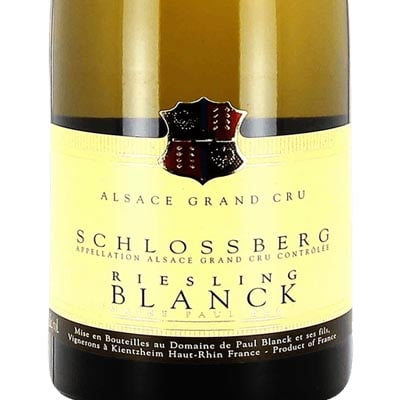
SOIL :
An exceptional vineyard: at 200-300m, the Schlossberg slope lies on the Kaysersberg migmatites and the intruding granite of Thannenkirch, of which the arenaceous character provides very fertile, mineral soil, composed both of coarse sand and clay.
The variety of minerals (potassium, magnesium, fluorine, phosphorus) determines the finesse and aromatic complexity of its wines.
Schlossberg slopes so steeply that vines are grown on terraces.
VINIFICATION :
The juice is extracted with infinite care in our air-bag press. The slow, gentle pressing avoids crushing the stalks and pips.
The must starts fermenting of its own accord thanks to the natural yeast present in the juice, and the fermentation generally lasts from 4 to 10 weeks. It is carried out in stainless-steel vats equipped with temperature control, a medium which maximises the expression of this variety's aromas.
ELEVAGE :
The wine is matured on its lees in large oak barrels for 12 months.
This lees-contact contributes richness to the wine. What is more, the oxygen which passes through the pores of the wood brings about a gentle oxidization of the wine, and the subsequent opening up of its aromas.
The wine is then bottled and aged for 2 to 3 further years before being offered for sale.
This bottle-ageing also plays a role in the wine's development. Here, the opposite of oxidization happens: thanks to certain reactions in the oxygen-free environment, the bouquet develops and takes on subtler nuances.
You May Also Like
-
Ch. Le Boscq St Estephe France 2011
Regular price HK$340Regular price -
Henriot Cuvee Hemera Brut 2008 (Gift Box)
Regular price HK$1,560Regular price -
Beaucastel Coudoulet de Beaucastel Cotes du Rhone 2020
Regular price HK$298Regular price -
Ch. Moulinet-Lasserre Pomerol 2019
Regular price HK$420Regular price


